On this page
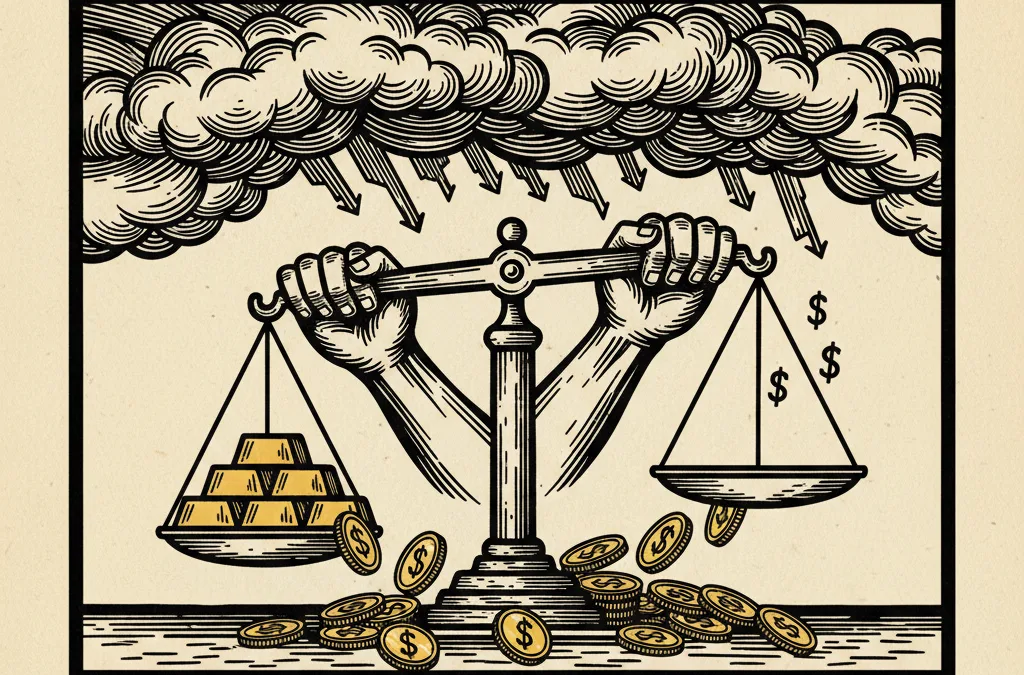
Gold’s Worst Week Since 1983 - But the Bounce Has Already Begun
Gold shed nearly 11% in a single week as a surging dollar and hawkish Fed rhetoric crushed momentum - yet the metal has already clawed back 2.7% from its lows, raising the question of whether the worst is over or just beginning.
What to know
-
Gold suffered its steepest weekly decline since 1983, dropping roughly 11% before stabilising around $4,524/oz - still down over 14% from its monthly high of $5,405.
-
Dollar strength and hawkish Federal Reserve signalling were the primary catalysts, repricing rate-cut expectations and pressuring non-yielding assets.
-
A partial recovery of +2.73% this week suggests dip-buying interest, but the metal remains deeply below its recent peak with silver hit even harder at -21% on the month.
What happened
Gold experienced its most violent weekly selloff in over four decades, plunging nearly 11% in a move that wiped out months of gains. The gold price cratered from the $5,000+ region to touch $4,100.80 at the monthly low - a staggering $1,304 peak-to-trough decline from the $5,405 high recorded earlier in March.
The speed of the move is what stands out. Gold had been trading in rarefied air above $5,000, and the correction - when it came - was brutal. At current levels of $4,524.30, the metal sits 16.3% below its monthly peak. Silver has fared even worse, shedding nearly 21% over the same period to trade at $69.80, pushing the gold/silver ratio down to 64.8.
This week has brought some relief. Gold has recovered $120.20, or 2.73%, while silver has edged up 1.08%. Platinum has also bounced 1.44% to $1,887.10. But these are modest rebounds against the scale of the damage.
Who’s involved
The Federal Reserve is the central actor here. Hawkish rhetoric from FOMC members has forced a sharp repricing of rate-cut expectations, and the dollar has surged in response. For gold - a non-yielding asset priced in dollars - this is the worst possible combination. Higher-for-longer rates increase the opportunity cost of holding bullion while a stronger greenback makes it more expensive for non-US buyers.
Momentum traders and leveraged long positions were caught badly offside. When gold broke below key technical levels around $4,800, stop-loss cascades likely accelerated the decline. The move from $5,405 to $4,100 has the hallmarks of a leveraged unwind rather than a fundamental reassessment.
Central bank buyers - who have been consistent accumulators over the past three years - are likely viewing this correction differently. For sovereign purchasers with multi-year allocation targets, a 16% discount from recent highs represents an opportunity rather than a crisis.
Why it matters
The 1983 comparison is instructive but imperfect. That selloff came during the painful aftermath of the Volcker-era rate shock, when gold was still unwinding from its 1980 speculative peak. Today’s backdrop is different - gold’s rally to $5,405 was driven by a broader set of structural factors including central bank diversification, geopolitical hedging, and persistent fiscal deficits.
The question is whether the Fed’s hawkish pivot represents a genuine policy shift or a temporary recalibration. If rate cuts are merely delayed rather than cancelled, gold’s structural bull case remains intact. The metal had arguably overshot on the upside, and a correction of this magnitude - while painful - is not unusual within secular bull markets. Gold fell 21% between August and October 2020 before resuming its uptrend.
Silver’s sharper decline of nearly 21% on the month reflects its dual nature as both a precious and industrial metal. When risk appetite collapses, silver’s industrial demand component becomes a liability rather than a support.
What happens next
The $4,100 low is now the critical line in the sand. If gold holds above that level on any retest, it would confirm a higher low and suggest the correction has run its course. A break below would open up the $3,800-$3,900 zone as the next support area.
FOMC communications over the coming weeks will be decisive. Any softening in hawkish language - particularly around the pace of balance sheet reduction or the terminal rate outlook - could trigger a sharp short-covering rally given how aggressively the market has repositioned.
The gold/silver ratio at 64.8 has compressed during this selloff, which is unusual - typically silver underperforms more sharply in risk-off moves. If the ratio starts climbing back toward 70+, it would signal that broader risk aversion is deepening.
Physical demand data from Asia, particularly China and India, will also be telling. Previous corrections of this scale have triggered significant physical buying in both markets, though whether that pattern repeats depends on local currency moves and consumer confidence.
This article is for informational purposes only and does not constitute financial advice. Always do your own research before making investment decisions.