On this page
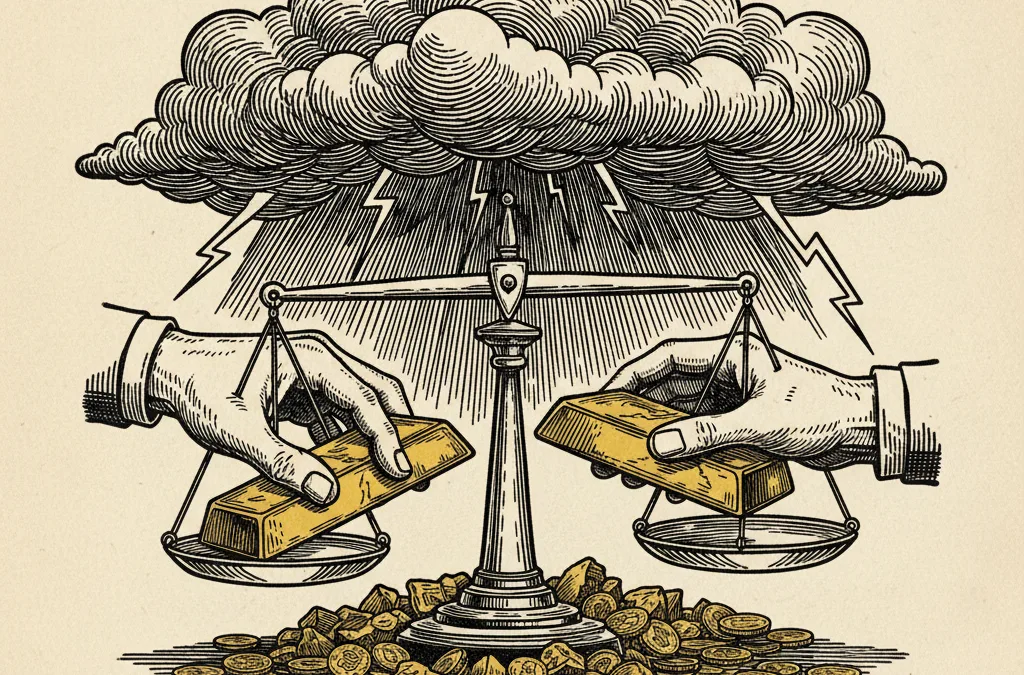
Gold Rebounds From 4% Plunge - But the Damage Lingers
Gold’s sharp sell-off to $4,618 on US-Iran escalation and dollar strength has partially reversed, but the episode exposes how vulnerable even a roaring bull market remains to geopolitical whiplash.
What to know
-
Gold plunged over 4% to $4,618 before recovering to $4,910 - still down nearly 4% on the month despite an 8.5% weekly bounce.
-
The sell-off was driven by a surging dollar and inflation fears tied to US-Iran military escalation, inverting gold’s usual safe-haven playbook.
-
Today’s US Non Farm Payrolls and unemployment data could determine whether the recovery holds or another leg lower materialises.
What happened
Gold dropped 4% to $4,618 per ounce as US-Iran tensions escalated - but instead of triggering the classic safe-haven bid, the episode fuelled a dollar rally and stoked inflation fears that sent gold sharply lower.
The move was sharp even by 2026 standards. Gold has traded in a wide $4,100-$5,303 monthly range, and this plunge marked one of the fastest single-session drops of the year. Since then, the gold price has recovered to $4,910 - up 8.5% on the week - but remains nearly 4% below where it stood a month ago. Silver sits at $75.11, down over 9% on the month, while platinum and palladium have bounced 6.7% and 17.6% respectively on the week.
Who’s involved
The dollar is the protagonist. When geopolitical risk translates into energy supply disruption fears - as US-Iran tensions invariably do - the inflationary impulse can strengthen the greenback. Traders pricing in higher-for-longer rates and potential energy shocks rotated into dollar assets, pressuring gold mechanically.
Central bank buyers, who have been a structural pillar of gold demand above $4,000, appear to have stepped back during the volatility rather than aggressively buying the dip. Speculative positioning had been stretched long heading into the sell-off, amplifying the downside as leveraged longs were forced to liquidate.
Palladium’s 17.5% weekly surge suggests industrial metals traders are pricing in supply disruption risk more directly - particularly given the metal’s concentrated production base and sensitivity to geopolitical shipping routes.
Why it matters
Gold’s relationship with geopolitical risk is not as straightforward as the textbook suggests. When conflict scenarios drive dollar strength and inflation expectations simultaneously, gold can find itself squeezed from both sides. This is similar to the early phase of the Ukraine conflict in 2022, when gold initially spiked but then gave back gains as dollar strength and rate expectations took over.
What makes this different is the price level. Gold trading around $4,900 with this kind of intraday volatility - a monthly range exceeding $1,200 - signals a market that is deeply uncertain about its own fair value. The gold-silver ratio at 65.4 suggests silver is bearing the brunt of the risk-off mood, underperforming gold meaningfully on the month.
The broader concern is whether US-Iran escalation feeds into a sustained inflation impulse. If energy prices remain elevated and supply chains face disruption, the Fed’s rate path becomes even more uncertain - and that uncertainty, not the geopolitics itself, will ultimately determine gold’s direction.
What to watch
Today’s US employment data is critical. Non Farm Payrolls, the unemployment rate, and the U-6 underemployment measure all land today and will shape rate expectations heading into the second quarter. A strong print could reinforce the dollar bid and pressure gold back towards $4,600 support. A weak number might give gold bulls the ammunition to push back above $5,000.
Three things to watch closely: whether central bank buying re-emerges on any further dips below $4,800; the dollar index - if it holds recent gains, gold’s recovery will struggle for momentum; and the palladium-platinum spread, which is narrowing rapidly and often signals shifts in broader risk appetite across the metals complex. The $4,600 level is the line in the sand. If gold revisits it and holds, the bull market structure remains intact. If it breaks, we’re in different territory.
This article is for informational purposes only and does not constitute financial advice. Always do your own research before making investment decisions.