On this page
Gold Catches a Bid as Hot PPI Reignites Inflation Fears
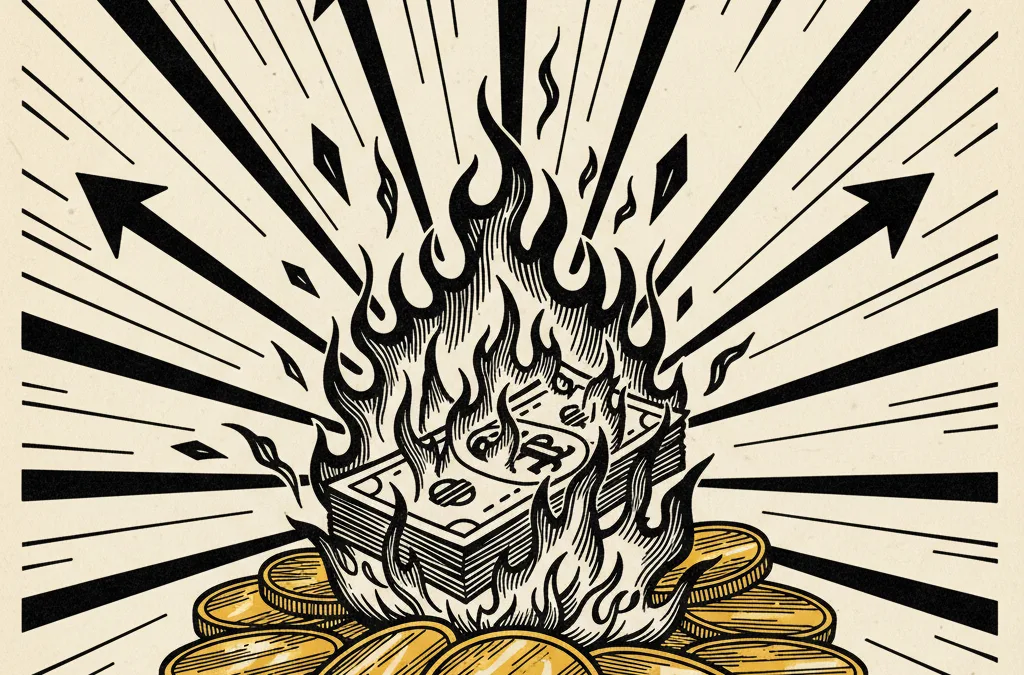
A hotter-than-expected 0.5% jump in US producer prices has handed gold bulls fresh ammunition, pushing the metal toward the top of its daily range near $4,868 as markets reassess the Federal Reserve’s rate path.
What to know
-
US PPI rose 0.5% month-on-month in March, well above consensus expectations, signalling persistent upstream inflation pressure.
-
Gold traded as high as $4,867.70 on the session and is up 2.37% on the week, though still down 2.64% from a month ago.
-
Silver outperformed gold on the day, gaining nearly 6% on the week with the gold-silver ratio compressing to 61.0.
What happened
US producer prices rose 0.5% in March - a reading that came in meaningfully above market expectations and injected fresh energy into the gold price during Monday’s session. Gold surged from a session low of $4,767.60 to touch $4,867.70, a move of roughly $100 intraday, before settling around $4,862.
The PPI print matters because producer prices sit upstream of consumer inflation. A 0.5% monthly increase suggests that cost pressures in the pipeline have not abated, despite the Federal Reserve’s prolonged restrictive stance. For gold, which thrives when real yields are under threat from sticky inflation, this is the kind of macro signal that draws buyers off the sidelines.
On a weekly basis, gold is now up 2.37%, clawing back some of the 2.64% decline seen over the past month. The metal remains well within its broader monthly range of $4,100.80 to $5,017.60, but the direction of travel since last week’s lows has been decidedly upward.
Who’s involved
The immediate beneficiaries are momentum-driven gold longs who have been waiting for a macro catalyst to re-enter positions after the pullback from the $5,017 monthly high. Institutional flows into gold ETFs have been a reliable barometer in recent months, and a sustained move above $4,850 could trigger further allocation.
Silver has arguably attracted even more aggressive positioning. The white metal gained nearly 6% on the week to $79.66, compressing the gold-silver ratio to 61.0 - a level that suggests silver is being treated less as an industrial laggard and more as a leveraged play on the inflation trade. Platinum and palladium have followed the complex higher, with platinum up 3.18% on the week to $2,115.80.
On the other side of the trade, the Federal Reserve finds itself in an increasingly uncomfortable position. Hot PPI data makes it harder to justify any near-term easing, but the persistence of elevated producer costs also raises the spectre of a policy error if the economy slows while prices remain sticky.
Why it matters
The relationship between PPI surprises and gold has strengthened considerably over the past two years. When producer prices run hot, markets begin pricing in a longer period of elevated inflation - and that erodes confidence in the purchasing power of fiat currencies. Gold benefits directly.
This reading is significant because of the context. Markets had been cautiously pricing in the possibility of rate cuts later this year. A 0.5% PPI print disrupts that narrative and forces a recalibration. If consumer price data follows a similar trajectory, the Fed’s hands are tied - and gold’s floor becomes considerably firmer.
The broader precious metals complex moving in sympathy reinforces the macro nature of this bid. This is not a gold-specific story driven by central bank buying or geopolitical risk. It is a broad inflation trade, and those tend to have longer legs than single-catalyst rallies.
What happens next
The next critical data point is US CPI, which will either confirm or contradict the PPI signal. If consumer prices echo the upstream pressure, gold could make another run at the $5,000 level. ADP employment data, also due this week, will add colour to the labour market picture - strong jobs data alongside hot inflation would be the most bullish macro combination for gold, as it suggests the economy can absorb higher prices without cracking.
Technically, gold needs to hold above $4,850 on a closing basis to maintain upward momentum. A failure there likely sends the metal back toward $4,750 support. The gold-silver ratio at 61.0 is also worth monitoring - further compression below 60 would signal that the inflation trade is broadening and intensifying.
Fed Funds futures pricing will show whether rate cut expectations are being pushed beyond Q3 - a shift that would be a powerful tailwind for gold into the summer months.
This article is for informational purposes only and does not constitute financial advice. Always do your own research before making investment decisions.