On this page

Gold Bounces Back From 5% Drop as Iran Fears Reignite
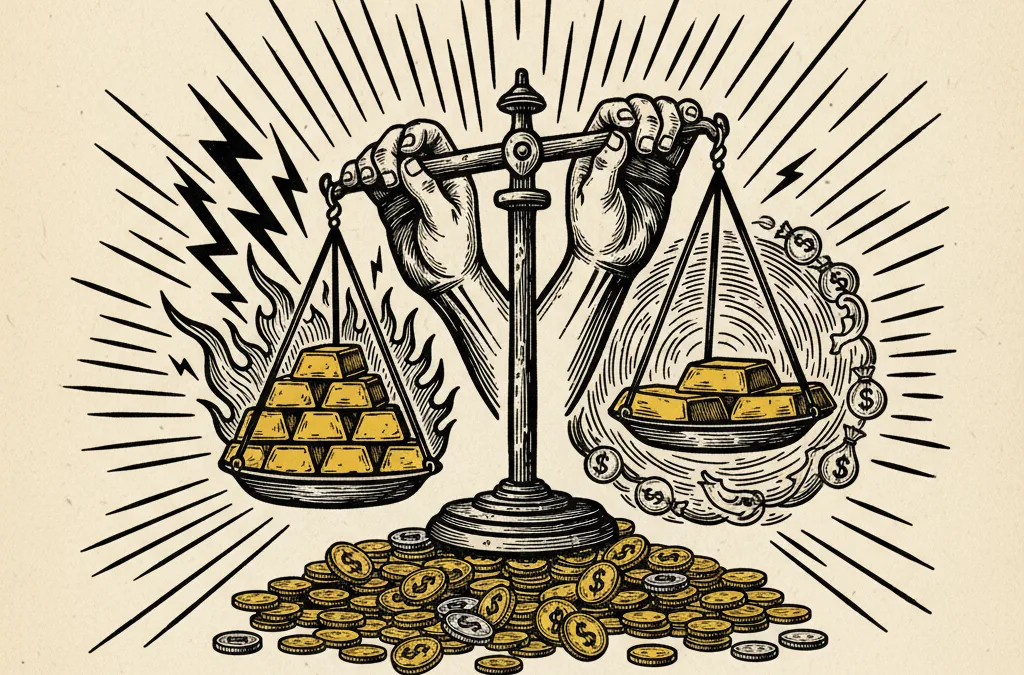
Gold’s sharp recovery from a steep selloff underscores how quickly geopolitical risk can override even aggressive profit-taking in a market trading above $5,200.
What to know
-
Gold has rebounded to $5,203.90/oz after a 5% drop, with the monthly range spanning $4,655 to $5,405 - a $750 swing reflecting extreme volatility.
-
Escalating Iran conflict fears are driving renewed safe-haven flows, with gold up 5.76% over the past month despite the recent pullback.
-
The gold/silver ratio sits at 60.3, with silver underperforming gold’s recovery - a divergence worth monitoring for signs of whether this rally has broad precious metals support.
What happened
Gold is trading at $5,203.90/oz after recovering from a 5% selloff that dragged prices toward the $4,655 monthly low. Today’s intraday range of $5,092.80 to $5,214.70 shows buyers stepping in aggressively on dips. Over the past week, gold has added $27.40, a 0.53% gain that masks the violence of the round trip.
Rising tensions around Iran have jolted safe-haven demand back to life just as momentum traders were booking profits. The 5% correction - which took gold from the $5,405 monthly high - looked like it might have legs. Instead, geopolitical risk reasserted itself as the dominant narrative within days.
Who’s involved
Central banks remain the structural bid underneath this market. Their multi-year accumulation trend hasn’t wavered, and pullbacks like the one we just witnessed tend to attract sovereign buying. Institutional allocators who missed the run from $4,900 are likely viewing the dip toward $4,655 as the entry they’d been waiting for.
Momentum-driven funds that rode gold higher were clearly trimming exposure during the selloff. The speed of the recovery suggests that selling pressure was shallow - more repositioning than conviction. Retail flows into gold-backed ETFs have been elevated throughout 2026, and this kind of geopolitical headline only reinforces the allocation case for individual investors.
Silver isn’t keeping pace. At $86.26/oz, it’s down 0.85% on the week while gold pushes higher. Platinum ($2,175.40) and palladium ($1,721.00) are also lagging, down 2.48% and 1.58% respectively on the week. This divergence signals that the current bid is pure safe-haven demand rather than a broad precious metals reflation trade.
Why it matters
Gold sells off on profit-taking, a geopolitical flashpoint emerges, and prices recover to new trading ranges. What’s different this time is the scale. A $750 monthly range ($4,655–$5,405) represents roughly 15% peak-to-trough volatility - the kind of swings typically reserved for crisis markets, not a metal in a sustained uptrend.
The Iran situation adds a layer of complexity that markets haven’t fully priced. Energy supply disruption risk feeds directly into inflation expectations, which in turn supports gold’s appeal as a real-asset hedge. If tensions escalate further, the $5,405 high becomes a floor, not a ceiling.
The macro backdrop this week matters. U.S. ADP employment data and ISM Services PMI land today, and both carry implications for Federal Reserve policy expectations. Strong numbers could temporarily strengthen the dollar and pressure gold. But the market’s behavior over the past week suggests that geopolitical demand is overwhelming macro data sensitivity - a shift from the rate-driven trading that dominated earlier this year.
The gold/silver ratio at 60.3 reinforces the safe-haven thesis. When gold outperforms silver this clearly, it’s fear - not inflation or industrial demand - driving the bus.
What to watch
The $5,405 monthly high is the immediate resistance level. A clean break above it on sustained Iran tensions would open the door to price discovery territory. On the downside, the $5,092 intraday low from today’s session is the near-term support to hold.
Silver deserves attention. If it starts catching up to gold - pushing the ratio back below 58 - it would signal broadening demand beyond pure haven flows. That’s a more durable bullish setup for the entire precious metals complex.
Today’s ISM Services PMI and ADP employment data could remove the last headwind for gold bulls if either prints soft, reinforcing rate-cut expectations. China’s manufacturing PMI, also due, matters for industrial metals sentiment and could spill into platinum and palladium positioning.
The Iran situation remains unpriced. Escalation likely tests $5,500, but how quickly tensions could reverse - and whether $5,000 holds on any pullback - depends on developments that haven’t happened yet.
This article is for informational purposes only and does not constitute financial advice. Always do your own research before making investment decisions.
Sources & Data
- Federal Reserve - FOMC statements and Fed communications