On this page

Gold at $5,158 - But the Street Can’t Agree Where It Goes Next
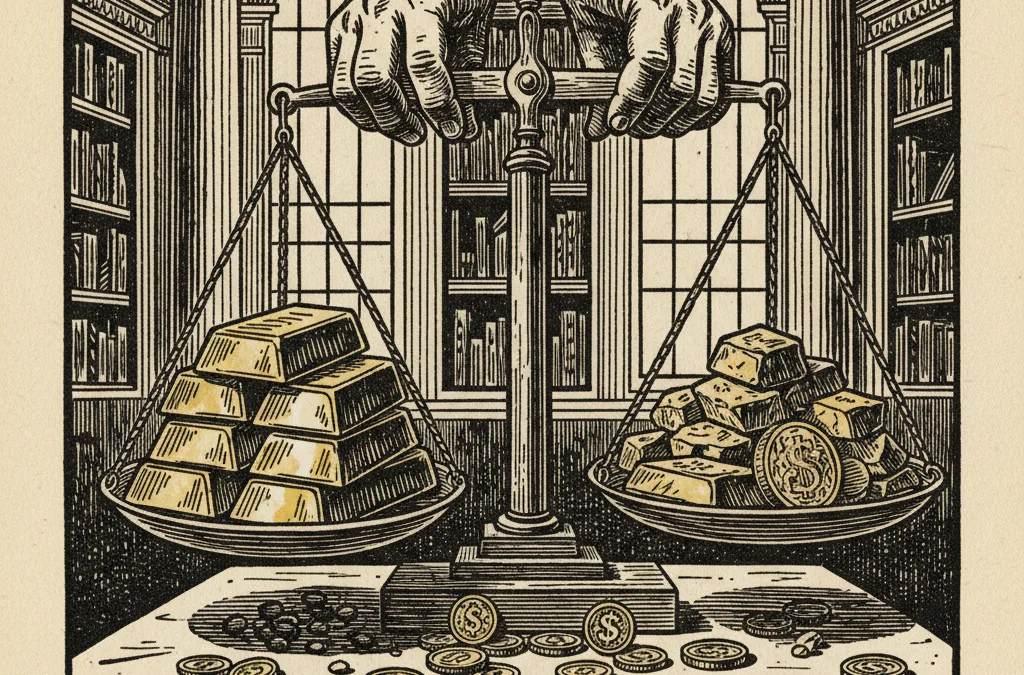
JP Morgan, ANZ, and HSBC are offering sharply divergent gold forecasts for 2026, and the disagreement itself may be the most telling signal for where prices head from here.
What to know
-
Gold is trading at $5,158.70/oz after pulling back 2.56% on the week from a monthly high near $5,405, leaving the metal caught between strong year-to-date momentum and short-term exhaustion.
-
Major institutional forecasts from JP Morgan, ANZ, and HSBC reveal meaningful disagreement on gold’s trajectory - a rare split among top-tier banks that typically signals an inflection point.
-
The broader precious metals complex has weakened sharply this week, with platinum down 7.36% and palladium off 5.68%, suggesting gold’s pullback is part of a wider risk recalibration.
What happened
Gold is sitting at $5,158.70/oz, nursing a 2.56% weekly decline after touching $5,405 earlier this month. The pullback has brought the metal back to a zone where institutional conviction is being tested - and the results are revealing. Three of the world’s most influential commodity desks - JP Morgan, ANZ, and HSBC - have laid out markedly different visions for where gold prices head through the remainder of 2026.
This kind of forecast divergence at elevated price levels is unusual. When gold was grinding through $2,000 in 2023–2024, the major banks were broadly aligned on a bullish trajectory. The current split suggests the market has entered a phase where the easy consensus trades are behind us, and the macro drivers are genuinely ambiguous.
The month-to-date picture remains constructive - gold is up 2.13% since early February - but the weekly slide, combined with broad weakness across precious metals, has introduced a note of caution that wasn’t present a fortnight ago.
Who’s involved
JP Morgan has historically leaned bullish on gold during periods of fiscal expansion and central bank accumulation, and their 2026 positioning appears consistent with that framework. ANZ, which has built a strong track record on commodity calls in recent years, is reportedly taking a more measured stance - likely reflecting Asia-Pacific demand dynamics and currency considerations. HSBC, often the most conservative of the three on precious metals, appears to be anchoring expectations closer to current levels or below.
Speculative length in gold futures remains elevated but has been trimming over the past two weeks, consistent with the price action. Central bank buying - the dominant structural bid since 2022 - continues, but the pace has moderated from the extraordinary levels seen in late 2024 and early 2025.
Meanwhile, the broader metals complex is flashing caution. Silver has dropped 4.50% on the week to $84.31, platinum has shed 7.36% to $2,141.70, and palladium is down 5.68% to $1,662.40. The gold-silver ratio at 61.2 remains compressed by historical standards, suggesting silver hasn’t yet decoupled from gold’s gravitational pull - but the sharper silver decline hints at industrial demand concerns creeping in.
Why it matters
Institutional forecast divergence at major price levels has historically preceded periods of elevated volatility. The last time we saw a comparable split among top-tier banks was in mid-2020, when gold was approaching $2,000 for the first time. What followed was a sharp breakout, a blow-off top, and then an 18-month consolidation.
The parallel isn’t exact - the structural backdrop today is arguably stronger, with sovereign debt levels far higher and de-dollarisation trends more entrenched - but the pattern of disagreement preceding a decisive move is worth noting.
Gold’s journey from $2,000 to $5,000 has been driven by a confluence of central bank buying, geopolitical hedging, and inflation persistence. The question now is whether those drivers have enough remaining force to push through the $5,400–$5,500 zone, or whether the market needs to consolidate and reset expectations.
What to watch
Three things are on my radar. First, the $4,850 level - the monthly low - is the near-term line in the sand. A break below that would suggest the pullback has legs and could validate the more cautious institutional forecasts.
Second, central bank purchase data for Q1 2026. If buying volumes have decelerated meaningfully from 2025’s pace, the structural bid that has underpinned this entire rally could soften.
Third, the gold-silver ratio. At 61.2, it’s telling us silver is broadly keeping pace. If that ratio starts expanding sharply - silver underperforming gold - it often signals a defensive rotation within precious metals that precedes broader weakness. The resolution of this institutional disagreement will likely define the next $500 move, but we don’t yet know which forecast will prove prescient.
This article is for informational purposes only and does not constitute financial advice. Always do your own research before making investment decisions.