On this page

Gold Surges Past $5,100 as US-Iran Tensions Escalate
A 2% single-session spike in gold prices driven by widening US-Israel conflict with Iran underscores just how quickly geopolitical risk can reprice the entire precious metals complex - and the move may not be over.
What to know
-
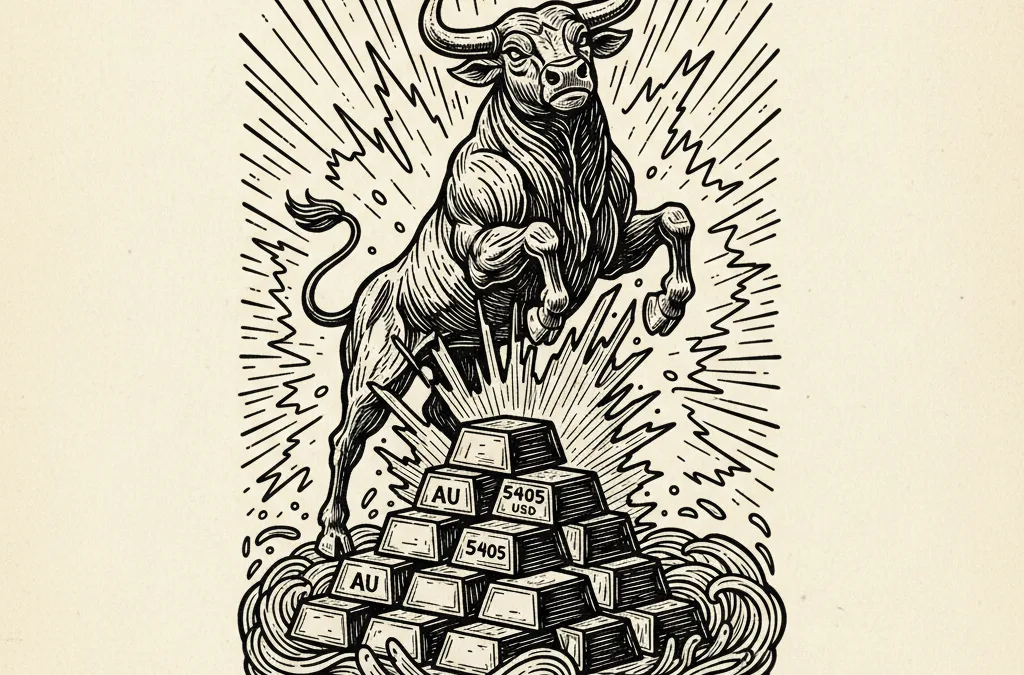
Gold jumped 2% in a single session as US-Israel-Iran tensions escalated, with prices touching an intraday high of $5,394.20 before settling near $5,160.
-
The monthly gain now stands at over 5.2%, with gold trading in a wide $4,655–$5,405 range - a $750 band that reflects extreme uncertainty.
-
Silver and platinum are diverging sharply from gold, with silver down 10.2% on the week and platinum off 11.7%, suggesting this rally is pure safe-haven flows rather than broad metals demand.
What happened
Gold ripped 2% higher in a dramatic session as the widening conflict between the US, Israel, and Iran injected a fresh wave of safe-haven demand into the market. The gold price spiked to an intraday high of $5,394.20 - flirting with the $5,400 level - before pulling back to trade around $5,160 as of Monday morning.
The sheer breadth of the daily range stands out. Gold swung between $5,081 and $5,394 in a single session - a $313 spread that represents over 6% of the current price. That kind of intraday volatility hasn’t been common outside of major geopolitical shocks. The monthly picture is equally striking: gold is up 5.23% over the past 30 days, adding $256 per ounce since early February.
Who’s involved
The key actors here are obvious - the US, Israel, and Iran - but the market positioning tells a more nuanced story. Institutional money has been rotating aggressively into gold for weeks, and this latest escalation appears to have triggered a wave of momentum buying on top of already elevated safe-haven positioning.
Central banks remain net buyers globally, a structural tailwind that has helped push gold from the $4,600s to above $5,100 in just one month. Retail demand is also surging; the gold/silver ratio sitting at 63.2 suggests investors are overwhelmingly favoring gold over silver as their precious metals hedge, which is typical during periods of acute geopolitical stress.
Meanwhile, the industrial metals within the complex are telling a completely different story. Silver has collapsed 10.2% on the week. Platinum is down 11.7%. Palladium has shed 8.4%. This divergence is critical - it confirms the gold move is driven almost entirely by flight-to-safety flows rather than any broad inflationary or commodity-cycle bid.
Why it matters
The 2% spike matters less than what it reveals about market fragility. Gold is now functioning as the primary geopolitical hedge in a way it hasn’t since the early stages of the Ukraine conflict. The speed of the move - and the subsequent partial retracement - suggests the market is pricing in escalation risk but hasn’t yet committed to a sustained conflict premium.
Historically, geopolitical spikes in gold tend to fade within days unless the underlying situation deteriorates further. The 1990 Gulf War buildup, the 2020 Soleimani strike, and the February 2022 Russia-Ukraine invasion all produced sharp initial moves, but only sustained conflicts kept prices elevated. The question now is whether this follows the spike-and-fade pattern or marks the beginning of a structural repricing.
Adding another layer: EU inflation data dropping today could reinforce gold’s bid if price pressures remain sticky. Higher inflation in Europe would likely weaken the euro, strengthen the dollar, and yet still support gold - a dynamic that has defined 2025 and 2026, where gold has repeatedly rallied alongside dollar strength, breaking its traditional inverse correlation.
What to watch
The $5,400 resistance level is the first thing on my radar this week - gold touched $5,394 and retreated. A clean break above $5,400 would signal that the market is embedding a durable conflict premium rather than trading a headline spike.
Second, the gold/silver ratio. At 63.2, it’s elevated but not extreme. If it pushes toward 70, that would confirm a pure fear trade with no industrial demand component - a setup that historically precedes either a sharp gold correction or a silver catch-up rally.
Oil is the third variable. Middle East escalations that threaten energy supply chains create a feedback loop: higher oil fuels inflation expectations, which in turn supports gold. Whether crude moves meaningfully higher this week will determine if the gold bid has legs beyond the initial geopolitical impulse.
This article is for informational purposes only and does not constitute financial advice. Always do your own research before making investment decisions.