On this page
Gold Supply Politics Heat Up as US, China Squeeze Ghana
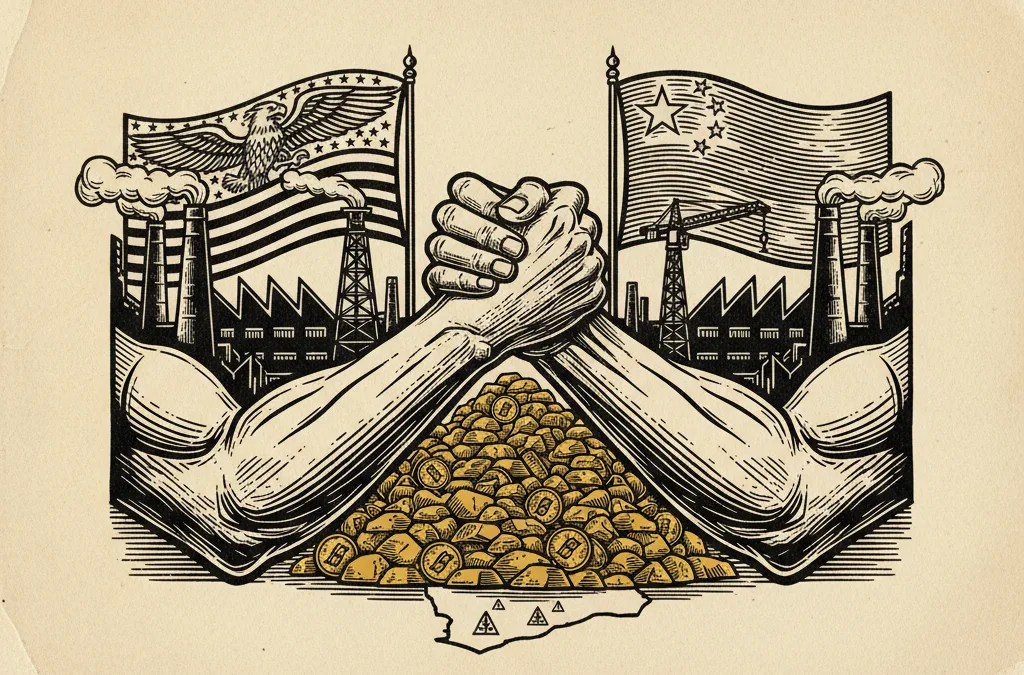
In a rare display of alignment, the world’s two largest economies are jointly pressuring Africa’s top gold producer to abandon a planned royalty increase - a move that exposes just how strategic physical gold supply has become at $5,100+.
What to know
- China and the US are both pressuring Ghana to reverse a proposed gold mining royalty hike, marking unusual geopolitical alignment on commodity policy.
- Ghana is Africa’s largest gold producer and a top-10 global supplier, making its fiscal policies material to the broader gold supply chain.
- Gold is trading at $5,131/oz, flat on the day but up 5.5% on the month, with supply-side policy risks adding a new dimension to an already tight market.
What happened
Ghana, Africa’s largest gold producer and the world’s sixth-largest overall, is facing coordinated diplomatic pressure from both the United States and China to shelve a planned increase in gold mining royalties. The proposed hike - which would raise the effective tax burden on miners operating in the country - has drawn an unusually unified response from Washington and Beijing, two capitals that agree on almost nothing else in 2026.
Gold itself is barely reacting today, trading at $5,131.20/oz with a negligible $0.60 move. But the broader monthly picture tells a different story: gold is up 5.5% over the past 30 days and traded as high as $5,405 this month. The metal has pulled back nearly 2% on the week, but the macro backdrop - with US initial jobless claims due later today and ECB commentary expected - keeps the bid alive.
Who’s involved
The three-way dynamic here is unusual. Ghana’s government, seeking to capture more revenue from a commodity trading above $5,000/oz, has a straightforward fiscal motivation. When gold was at $1,800 three years ago, existing royalty structures were arguably generous to miners. At current levels, Accra’s desire to renegotiate terms is economically rational.
On the other side, Chinese and American interests converge for different reasons. China has been aggressively securing physical gold supply chains across West Africa, with state-linked entities expanding their footprint in Ghanaian mining. Higher royalties cut directly into those margins. The US, meanwhile, has major mining companies - Newmont being the most prominent - with significant Ghanaian operations. Newmont’s Ahafo and Akyem mines are cornerstone assets, and any royalty increase flows straight to the bottom line.
The fact that both superpowers are applying pressure simultaneously suggests that at $5,000+ gold, supply security has moved from a corporate concern to a national strategic priority.
Why it matters
This episode fits a pattern across the gold mining landscape. Resource nationalism tends to accelerate when commodity prices surge - we saw it in copper across Latin America, and now it’s reaching gold in West Africa. Ghana produced roughly 4 million ounces in 2025, representing approximately 3% of global mine supply. That’s not a marginal figure.
The geopolitical dimension elevates this beyond a standard fiscal policy dispute. When the US and China jointly lean on a sovereign nation over mining taxation, it signals that physical gold supply is being treated as a strategic asset class, not just a financial one. The same logic underpins the broader central bank accumulation trend that has driven gold from $2,000 to $5,000+ over the past three years.
For the gold market, the immediate price impact is limited - this isn’t a supply disruption. But it establishes a precedent. If Ghana backs down, other gold-producing nations considering similar royalty adjustments (Tanzania, Burkina Faso, Mali) will take note. If Ghana holds firm, it could trigger a wave of copycat policies across the continent, tightening margins industry-wide and potentially constraining future supply growth.
What to watch
Ghana’s parliamentary timeline matters - royalty changes require legislative action, and the political calculus in Accra will determine whether this pressure campaign succeeds. Newmont and Gold Fields earnings guidance should quantify the potential impact if either company addresses Ghanaian fiscal risk in upcoming calls. The gold/silver ratio at 61.9 suggests silver has been outperforming recently, but any supply-side disruption narrative tends to favor gold specifically, which could push that ratio back toward 65.
With US jobless claims data dropping today and gold already showing intraday volatility between $5,085 and $5,204, the macro backdrop remains supportive. Whether Ghana’s government holds firm or capitulates will set the tone for resource nationalism across African gold producers for the next 12-18 months.
This article is for informational purposes only and does not constitute financial advice. Always do your own research before making investment decisions.
Sources & Data
- World Gold Council - quarterly Gold Demand Trends report
- European Central Bank - ECB speeches and policy statements
- ONS - ONS Retail Price Index data