On this page
Gold Holds $5,200 as Tariff Risks Reshape the Macro Playbook
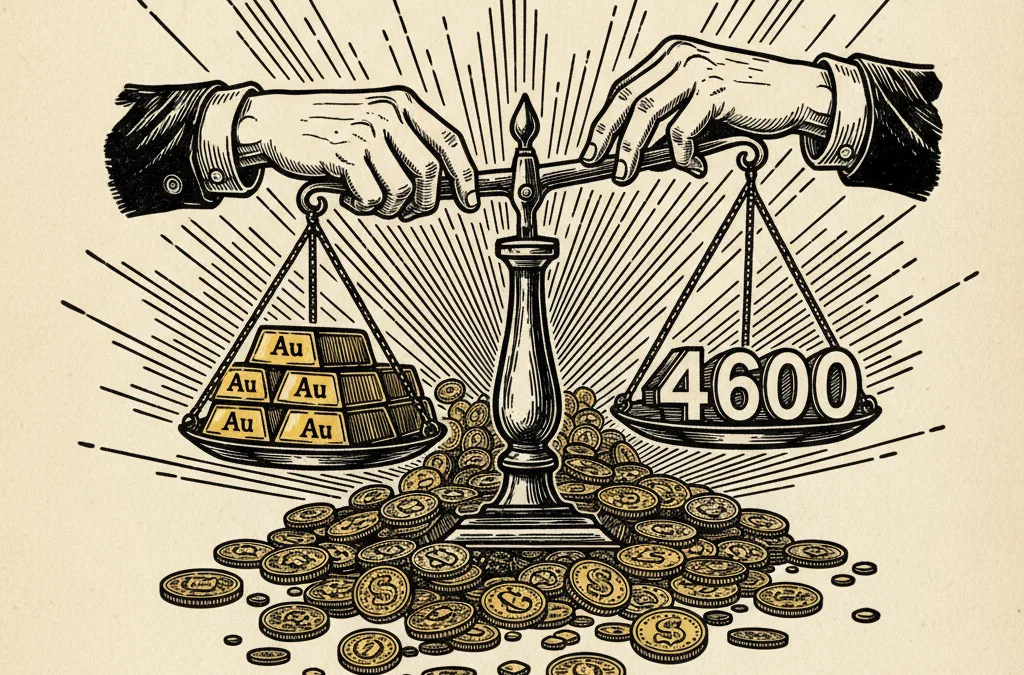
U.S. tariff policy is emerging as the next major catalyst for gold, and at $5,201 per ounce, the market is already pricing in significant uncertainty.
What to know
-
Gold is trading at $5,201.80/oz, up 2.82% on the week and 2.40% on the month, with an intraday range touching $5,221.90.
-
Shifting U.S. tariff policy is creating a feedback loop through currency markets, inflation expectations, and safe-haven demand that directly impacts gold pricing.
-
The gold/silver ratio sits at 59.3, suggesting relative strength in silver even as gold consolidates near record territory.
What happened
Gold is consolidating above $5,200 per ounce as markets digest the growing possibility that U.S. tariff policy could shift materially in the coming months. The gold price touched $5,221.90 intraday before pulling back slightly to $5,201.80 - a weekly gain of $142.50, or 2.82%. The broader monthly range has been extraordinary, spanning from $4,400 to $5,586.20, a $1,186 band that underscores just how volatile the macro backdrop has become.
The bid reflects a convergence: tariff uncertainty is feeding into dollar volatility, which in turn is amplifying gold’s appeal as a currency-neutral store of value. The flat daily change of 0.00% suggests orderly positioning rather than rushed flows.
Who’s involved
The key players here sit at the intersection of trade policy and monetary strategy. The White House’s tariff agenda remains the primary variable, with any escalation - or de-escalation - capable of moving gold $100 or more in a single session, as the monthly range demonstrates.
Central banks remain significant accumulators. The multi-year trend of sovereign gold buying, particularly from non-Western central banks seeking to diversify away from dollar reserves, gets turbocharged every time tariff rhetoric heats up. If tariffs weaken global trade flows, the incentive to hold gold over trade-sensitive currencies only grows.
Institutional desks, including Deutsche Bank’s macro strategy team, are actively modeling the transmission mechanism from tariffs to gold. The logic runs through several channels: tariffs push up import costs, stoking inflation expectations; they weaken trading partners’ currencies against the dollar in the short term but undermine long-term dollar credibility; and they inject geopolitical risk premium into every asset class - all of which historically favor gold.
Why it matters
The tariff-gold nexus is more potent in 2026 than it was during the 2018-2019 trade war cycle. Back then, gold rallied from roughly $1,200 to $1,550 - a 29% move - as U.S.-China tariffs escalated. The difference now is scale. Gold at $5,200 reflects years of accumulated monetary expansion, persistent inflation, and a structural shift in central bank reserve preferences. Any additional tariff shock lands on a market that’s already running hot.
The currency channel deserves particular attention. Tariffs tend to create a paradox for the dollar: short-term strength as capital flows to U.S. assets, but medium-term weakness as trade disruptions erode economic fundamentals. Gold thrives in both phases - as a hedge against dollar strength for non-U.S. buyers, and as a hedge against dollar weakness for everyone else.
Silver’s 6.62% weekly gain and the compressed gold/silver ratio at 59.3 suggest the broader precious metals complex is catching a macro bid, not just gold. Platinum is up 4.01% on the week at $2,256.80. When the entire sector moves in tandem, it typically signals macro positioning rather than metal-specific demand.
What to watch
This week’s Initial Jobless Claims data landing today could shift the narrative. A weaker labor market reading would reinforce the case for Fed easing, adding another tailwind for gold on top of tariff uncertainty. A strong print might temper expectations and test the $5,144 support level seen in today’s low.
Three variables matter most: any concrete tariff announcements or executive orders that move beyond rhetoric; the dollar index’s reaction function - if DXY weakens on tariff news, gold could retest the $5,586 monthly high rapidly; and the gold/silver ratio, where a move below 55 would signal that industrial metals are pricing in inflationary tariff pass-through.
The $1,186 monthly range suggests a market waiting for direction rather than one that’s found equilibrium.
This article is for informational purposes only and does not constitute financial advice. Always do your own research before making investment decisions.