On this page
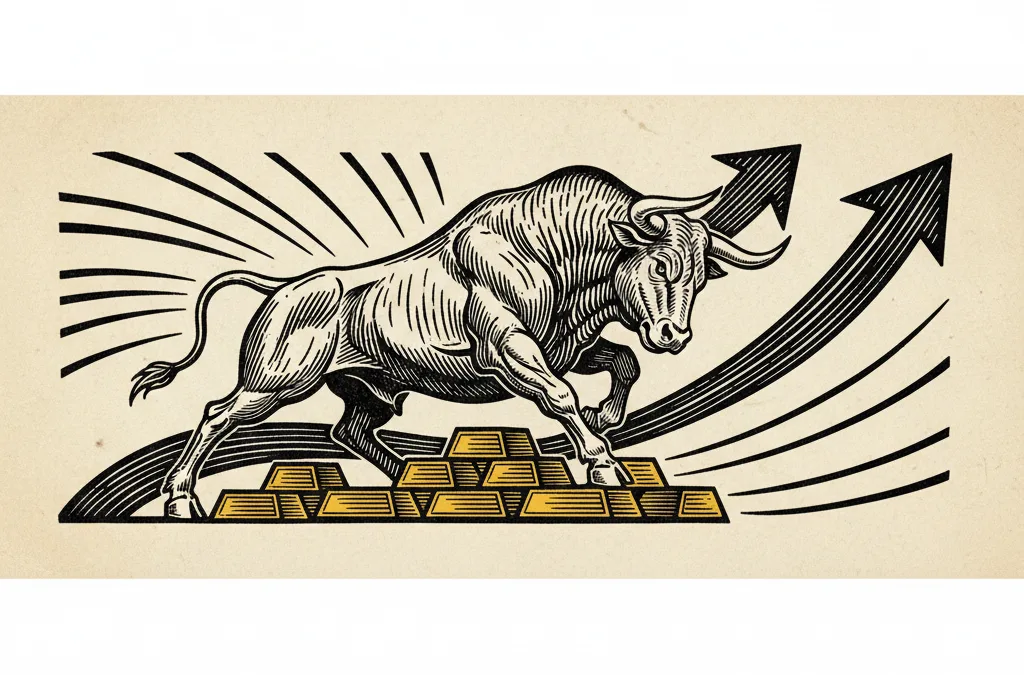
Gold’s 19% Surge Meets Resistance - But Bulls Aren’t Done
Gold has rallied nearly a fifth in value yet now faces a critical technical test near $4,900, with the outcome likely to define the metal’s trajectory into summer.
What to know
-
Gold has surged approximately 19% from its recent base, pushing toward the $4,900-$5,000 resistance zone before pulling back from an intraday high of $4,917.70.
-
The gold-silver ratio has compressed to 59.7, suggesting silver is outperforming on the week with an 8.36% gain versus gold’s 2.96%.
-
Two Fed speakers - Barkin and Waller - are scheduled for today, and their tone on rates could determine whether gold breaks higher or consolidates.
What happened
Gold has mounted a remarkable 19% rally over recent weeks, driving the gold price from the low $4,100 region to an intraday peak of $4,917.70 on 17 April. The metal is currently trading at $4,882.90, sitting just below the psychologically significant $5,000 level that has emerged as a major resistance ceiling.
The weekly gain of $140.50 - or just under 3% - tells only part of the story. Zoom out and the broader picture is one of sustained buying pressure that has pushed gold through multiple technical levels. The month’s range of $4,100.80 to $5,017.60 represents a spread of over $900, an unusually wide band that reflects genuine conviction from buyers and fierce defence from sellers near the $5,000 mark.
Gold touched $4,917.70 before retreating, printing a wide daily range of nearly $132. That kind of intraday volatility at resistance is textbook indecision - bulls testing the ceiling, bears pushing back.
Who’s involved
Central bank demand continues to underpin the structural bid. Institutional flows into gold ETFs have been persistent throughout this rally, and the pace of accumulation suggests this is not purely speculative froth.
Silver is arguably the more aggressive trade right now. With an 8.36% weekly gain versus gold’s 2.96%, silver is leading the complex higher. The gold-silver ratio at 59.7 has compressed notably - a dynamic that historically accompanies the more mature phases of a precious metals rally, when risk appetite broadens beyond the safe-haven anchor.
Platinum and palladium are participating too, with weekly gains of 3.48% and 1.16% respectively. The entire complex is moving in the same direction, which lends credibility to the rally’s foundations.
On the macro side, two Federal Reserve speakers - Barkin and Waller - are due today. Their commentary will be parsed for any shift in tone on rate expectations. Gold’s sensitivity to Fed rhetoric has been acute this cycle, and any hint of dovishness could provide the catalyst for a clean break above $5,000.
Why it matters
A 19% rally in gold is not a routine move. It places this surge among the sharpest multi-week advances of the past decade. The last comparable burst came during the pandemic-era breakout of 2020, when gold cleared $2,000 for the first time. That rally also stalled at a round-number resistance level before eventually powering through.
The monthly change of -2.36% is worth noting. It suggests that while the broader trend is emphatically bullish, gold did experience a meaningful pullback from its $5,017.60 monthly high. That peak above $5,000 was brief and quickly rejected, reinforcing the level as the line in the sand.
The compression in the gold-silver ratio to 59.7 carries its own signal. When silver starts outperforming gold, it often reflects growing confidence that the rally has legs. Industrial demand for silver adds a growth-sensitive dimension that pure safe-haven flows into gold lack.
What happens next
The $5,000 level is the immediate technical battleground. A sustained daily close above it would likely trigger momentum-driven buying and open the path toward $5,200-$5,300. Failure to break through could see gold consolidate in the $4,700-$4,900 range, though the direction from there remains unclear given conflicting signals from Fed policy expectations and physical demand flows.
This article is for informational purposes only and does not constitute financial advice. Always do your own research before making investment decisions.