On this page
Gold Snaps Back After Brutal March - But Scars Remain
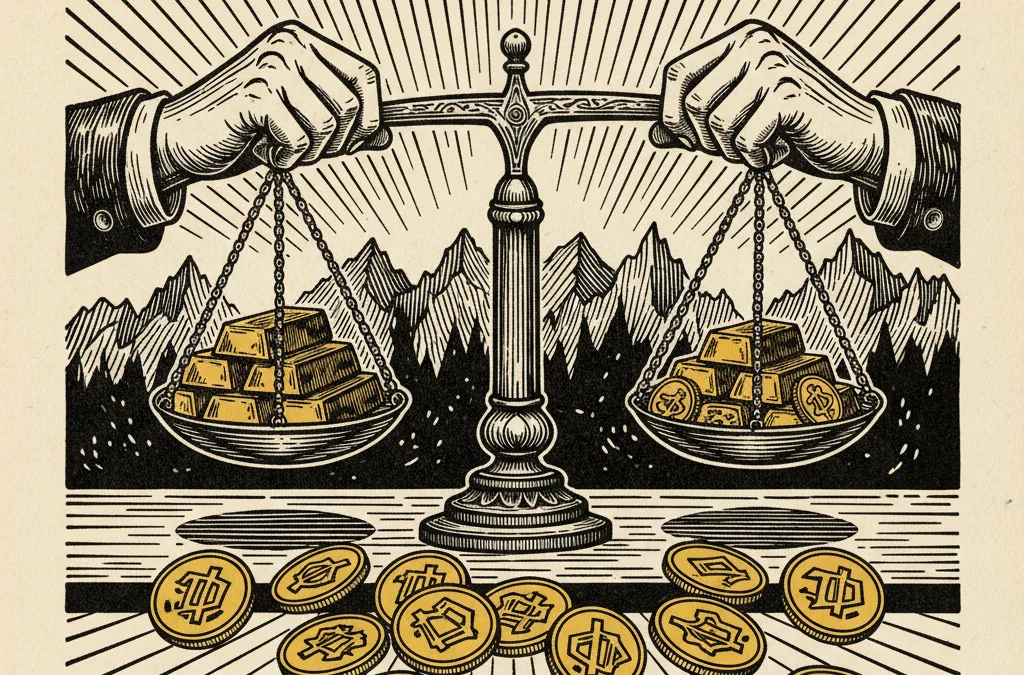
Gold has clawed back nearly 4% this week as buyers step in after March’s punishing $1,100 range swing, but the metal remains over 8% below its recent highs as fading U.S.-Iran tensions reshape the risk premium.
What to know
-
Gold trades at $4,702.70/oz, up 3.9% on the week but still down 8.15% from its March peak near $5,230.
-
The sharp March sell-off was driven by de-escalation in U.S.-Iran relations, stripping out a substantial geopolitical risk premium.
-
Silver has underperformed gold on the recovery, falling 11.45% over the past month versus gold’s 8.15% decline, pushing the gold/silver ratio to 64.3.
What happened
Gold’s monthly range stretched from $4,100.80 to $5,229.70 in March - a staggering $1,129 swing that tested the nerves of even seasoned bullion traders. The gold price currently sits at $4,702.70/oz, having gained $176.70 - or 3.9% - over the past week alone. That bounce, however, only partially reverses the damage from March, which saw gold shed $417.50 per ounce, an 8.15% drawdown from its month-high near $5,230.
The catalyst for March’s sell-off was clear: a meaningful de-escalation in U.S.-Iran tensions drained the geopolitical risk premium that had been baked into gold throughout the first quarter. When the threat of direct military confrontation receded, the safe-haven bid evaporated with remarkable speed.
Who’s involved
Central bank buyers, who have been the dominant structural force in gold markets for the past three years, appear to have used the dip towards $4,100 as an accumulation opportunity. The speed of the rebound from those lows suggests institutional demand remains robust beneath the surface.
Speculative positioning, by contrast, likely contributed to the violence of both moves. Leveraged long positions built during the Iran escalation were unwound aggressively in March, and the early April bounce has the hallmarks of fresh momentum buying rather than short covering alone.
Silver traders have fared worse. At $73.17/oz, silver is down 11.45% over the month - underperforming gold by a meaningful margin. The gold/silver ratio at 64.3 reflects this divergence, with silver’s industrial demand profile making it more vulnerable to risk-off positioning. Platinum and palladium have staged stronger weekly recoveries - up 6.06% and 6.84% respectively - suggesting the broader precious metals complex is finding its footing.
Why it matters
Geopolitical risk premiums can inflate rapidly but deflate even faster. Gold above $5,000 was pricing in a worst-case Iran scenario that did not materialise. The correction was swift and mechanical.
Gold has given back its entire Iran premium and needs to find a new narrative anchor. The structural bull case - persistent central bank demand, fiscal deficits across major economies, and de-dollarisation flows - remains intact. But the tactical picture is messier.
The broader precious metals recovery this week hints that the sell-off may have been overdone. When all four major metals bounce in unison, it typically signals that macro buyers are re-engaging rather than simply repositioning within the complex.
What comes next
The $4,700 level is the immediate line in the sand. A sustained hold here would suggest the market has digested the geopolitical repricing and is building a new base. A failure to hold opens the path back towards $4,400, where buyers stepped in during the March rout.
Any renewed friction in U.S.-Iran relations would reignite the risk premium trade instantly - and the speed of March’s move in both directions suggests the market is primed for outsized reactions to diplomatic headlines.
With gold having shed its geopolitical premium, the metal’s correlation with real rates and dollar strength becomes the dominant driver again. Silver’s underperformance also bears monitoring. If the gold/silver ratio begins compressing from 64.3, it would signal broader risk appetite returning to the metals complex.
This article is for informational purposes only and does not constitute financial advice. Always do your own research before making investment decisions.