On this page
Gold Holds $5,050 Despite Dollar Surge - But Iran Risks Linger
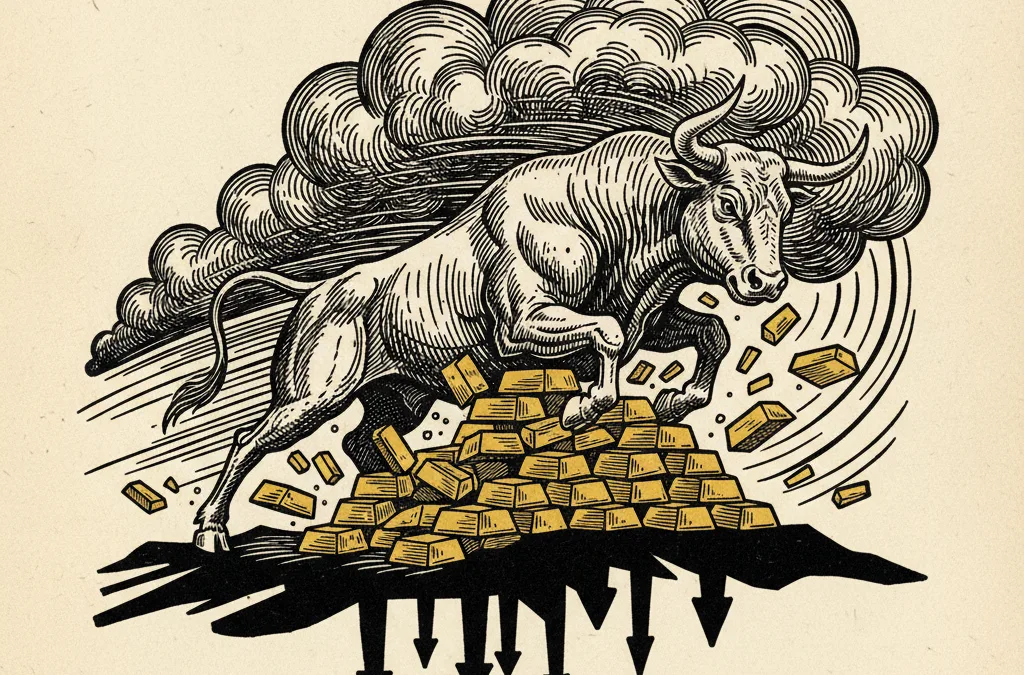
Gold’s intraday plunge below $5,050 on a resurgent dollar was swiftly bought back, revealing a market caught between currency headwinds and genuine geopolitical fear over Iran.
What to know
-
Gold traded in a wide $118 range on Friday, dipping to $5,014 before recovering to $5,061 as dollar strength clashed with escalating Iran conflict risks.
-
The broader precious metals complex is under pressure - silver is down 3.2% on the week, platinum has shed nearly 6%, and palladium has fallen close to 5%.
-
Despite the weekly pullback, gold remains up 3.7% on the month, suggesting dip-buyers continue to view sub-$5,050 levels as attractive entry points.
What happened
Friday’s session delivered a $118 intraday range - from $5,014 to $5,132 - as dollar strength forced leveraged longs to liquidate before physical buyers stepped in. Gold plunged to a session low of $5,014.10, then recovered to trade around $5,061.70 by the close.
The selloff was driven almost entirely by dollar dynamics. The greenback surged on the back of firmer-than-expected US economic signals, pushing gold below the psychologically significant $5,050 level for the first time in over a week. On a weekly basis, gold is down a modest 0.59%, or roughly $30, but the month-to-date picture remains firmly positive at +3.7%.
The broader precious metals complex fared worse. Silver dropped to $79.52 intraday before clawing back to $81.34, but the weekly loss of 3.2% is notable. Platinum took the hardest hit among the group, shedding 5.9% on the week to $2,042. Palladium mirrored the weakness, falling nearly 5% to $1,579.70. The gold-silver ratio sitting at 62.2 suggests silver is holding its relative ground better than the industrial-leaning metals, but the divergence bears watching.
Who’s involved
Dollar bulls have reasserted themselves after a period of relative calm, and the resulting currency strength is mechanically bearish for dollar-denominated commodities. Momentum traders and algorithmic systems likely amplified Friday’s move lower, particularly as gold breached the $5,050 support level.
Geopolitical risk buyers remain active. Escalating tensions around Iran - with the conflict showing no signs of de-escalation - are providing a persistent bid under the market. The speed of Friday’s recovery from $5,014 back above $5,060 suggests that physical buyers and longer-term allocators viewed the dip as an opportunity rather than a warning.
Central bank demand, which has been a structural pillar of gold’s advance from $2,000 to $5,000 over the past two years, appears undiminished by short-term volatility. The fact that gold has added nearly $179 in the past month alone, despite periodic dollar-driven corrections, speaks to the depth of underlying demand.
Why it matters
Dollar strength and geopolitical risk are pulling gold in opposite directions. Historically, a surging dollar has been enough to cap gold rallies - but that relationship has weakened considerably since central banks began diversifying reserves at an unprecedented pace. Gold’s ability to hold above $5,000 even during sharp dollar moves would have been unthinkable two years ago.
The Iran situation adds a layer of genuine uncertainty. Conflict-driven gold rallies tend to be sharp but short-lived unless they escalate into broader supply chain disruptions or energy shocks. The current episode sits atop an already bullish structural backdrop. Gold is not rallying into geopolitical risk from a position of weakness - it is consolidating near all-time highs.
The weakness in platinum and palladium is worth noting separately. These metals carry significant industrial exposure, and their steeper declines suggest the market is pricing in some economic slowdown risk that gold, as a pure monetary metal, is largely immune to.
What happens next
The $5,000 round number is the key level. A sustained break below it would signal that dollar strength is overwhelming the geopolitical bid, and could trigger a deeper correction toward the $4,850 area - the month’s low. Any fresh escalation in the Iran conflict that threatens energy supplies would likely send gold back toward the $5,400 level tested earlier this month.
The dollar index next week will determine whether silver and the PGMs suffer more than gold, potentially pushing the gold-silver ratio back above 65. The Iran situation remains fluid. With realised volatility this high, conviction trades in either direction look poorly supported by the available data.
This article is for informational purposes only and does not constitute financial advice. Always do your own research before making investment decisions.