On this page

Gold Clears $5,000 - But Thin Liquidity Tells the Real Story
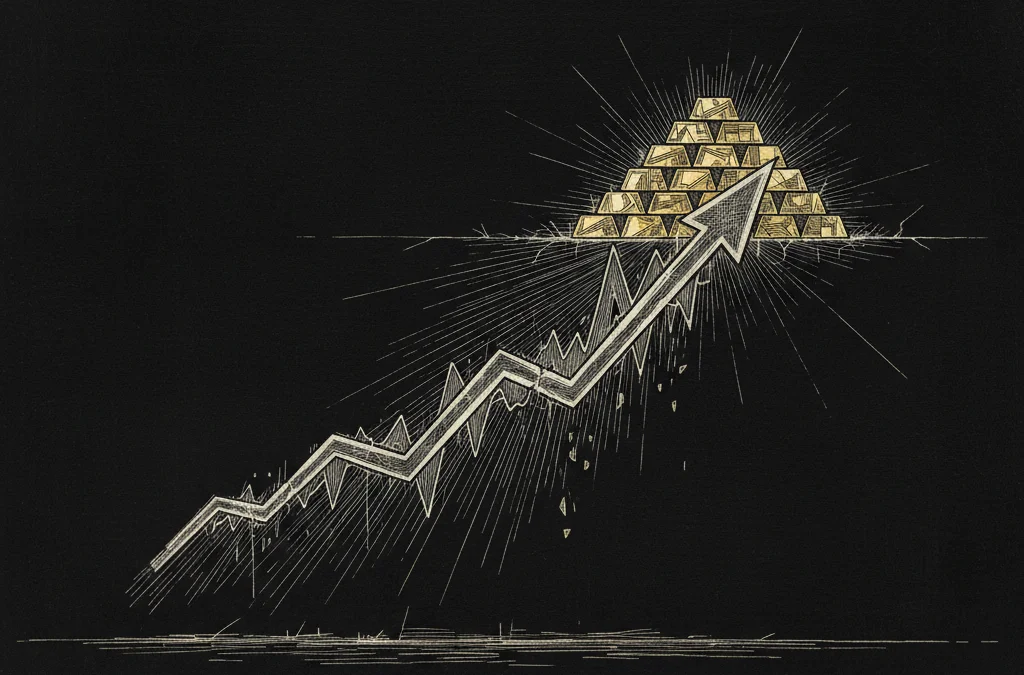
Gold’s breach of the $5,000 psychological barrier during a low-volume session reveals a market where dip-buyers are in control but conviction remains untested.
What to know
-
Gold traded as high as $5,031.90 intraday after touching a session low of $4,868.50 - a $163 range that underscores elevated volatility around the $5,000 level.
-
The metal is up 5.17% over the past month and 1.67% on the week, with dip-buying emerging as the dominant force in thin Presidents’ Day-adjacent trade.
-
Silver has diverged sharply, dropping 18% over the past month even as gold rallies, pushing the gold/silver ratio to 64.8.
What happened
Gold punched through $5,000 per ounce for the first time during regular trading, settling near $5,005.90 after a volatile session that saw the metal swing across a $163 range. The move came on notably thin volume - a hallmark of the Presidents’ Day holiday window - with buyers stepping in aggressively on dips toward the $4,868 level.
The gold price has now gained over $246 in the past month alone, a 5.17% advance that has accelerated since clearing the $4,750 resistance zone in early February. Gold has added roughly $600 since breaking $4,400 at the start of the month, a pace that echoes the parabolic runs seen during the 2020 pandemic rally and the 2011 sovereign debt crisis - both of which preceded sharp corrections.
Who’s involved
Dip-buyers are running the show. The intraday pattern - a steep drop to $4,868 followed by a snap recovery above $5,000 - suggests systematic buying programs and momentum-driven funds are treating every pullback as an entry point. This is classic late-stage trend behavior, where fear of missing the move outweighs valuation concerns.
Central bank accumulation continues to provide a structural bid beneath the market. The multi-year buying trend from emerging market central banks, particularly in Asia and the Middle East, has created a floor that didn’t exist during previous gold cycles. Meanwhile, ETF flows have been positive for six consecutive weeks, adding fuel to the rally.
Thin liquidity means market makers are widening spreads and pulling offers. That amplifies moves in both directions and makes the $5,000 level feel less confirmed than the headline suggests.
Why it matters
Psychological milestones matter in gold more than almost any other asset. The $1,000, $2,000, and $3,000 levels all triggered extended consolidation periods before the next leg higher. The question now is whether $5,000 becomes a launchpad or a ceiling.
The macro backdrop appears supportive so far. UK inflation data due today could reinforce the case for continued monetary easing from the Bank of England, while US housing starts and building permits data may offer clues on the Fed’s rate path. Any dovish signals would further weaken the dollar case against gold.
The divergence with silver is a warning sign worth monitoring. Silver has shed 18% over the past month even as gold surges, pushing the gold/silver ratio to 64.8. When gold rallies and silver doesn’t follow, it often signals that the move is driven more by safe-haven flows and speculative positioning than broad-based precious metals demand. Industrial metals weakness in silver and platinum (despite platinum’s 3.87% weekly gain) suggests the rally is narrowly concentrated.
The month’s range tells its own story: gold has traded between $4,400 and $5,586 - a $1,186 spread that represents nearly 24% of the lower bound. That kind of volatility typically precedes either a breakout to new highs or a violent mean reversion.
What to watch
The $5,000 level needs to hold on a weekly closing basis to confirm as support. A failure here likely triggers a retest of $4,750, where the 20-day moving average sits. Above, the intramonth high of $5,586 becomes the next target.
Volume normalization after the holiday window will be critical. If gold holds above $5,000 on full liquidity, the breakout gains credibility. If it slips back below on heavier volume, this session becomes a false flag.
The gold/silver ratio at 64.8 deserves close attention - a move above 70 would signal extreme gold-specific positioning and historically has preceded gold corrections. Whether US housing data and UK inflation prints shift rate expectations remains unclear, but the next 48 hours could determine near-term direction.
This article is for informational purposes only and does not constitute financial advice. Always do your own research before making investment decisions.
Sources & Data
- CFTC - weekly Commitment of Traders positioning data
- Bank of England - MPC minutes and policy statements
- ONS - ONS inflation statistics